DESYNCHRONIZED REALITIES
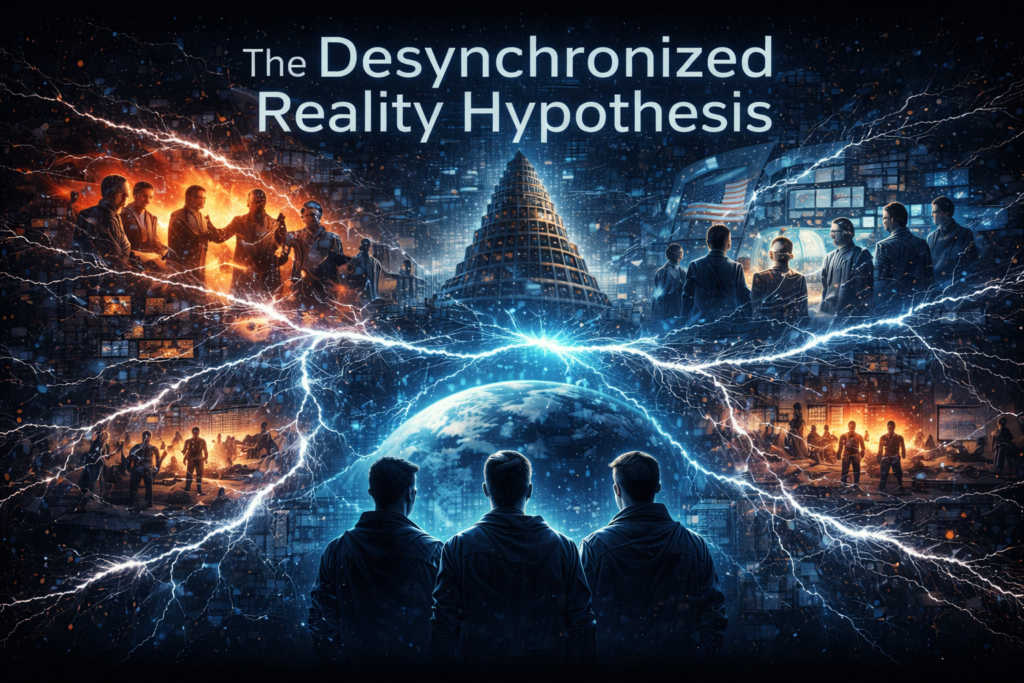
The Babel Hypothesis:
How Simulation Fragmentation Explains the Crisis of Shared Perception
Abstract
This paper proposes a novel extension to simulation hypothesis theory, which we term the Desynchronized Reality Hypothesis (DRH). Building upon the foundational work of Nick Bostrom†1 and incorporating insights from quantum mechanics, information theory, and cognitive psychology, we argue that if we are indeed living in a computer simulation, a critical malfunction has occurred in the synchronization layer that maintains perceptual coherence across observers. This desynchronization manifests as the increasingly fractured shared reality experienced by humanity, where individuals observing the same events arrive at starkly contradictory interpretations; much like witnesses seeing black where others see white.
We draw a striking parallel to the biblical Tower of Babel narrative†9, wherein humanity’s unified capacity for communication was deliberately fragmented, leading to confusion and dispersal. We propose that what ancient texts described as a confusion of language may be better understood as a confusion of perception itself. The paper concludes with a framework for potential resynchronization and the conditions under which humanity might restore coherent shared experience.
Skip to the Introduction!
A Speculative Scientific Treatise
by John J. Kirker
2026
Copyright © 2026 John Kirker Inc.
A California Corporation
All Rights Reserved Worldwide
Version 1.5
First Edition (Working Paper)
Originally Published: January 11, 2026
Made Public: January 16, 2026
Last Updated: January 19, 2026
Library of Congress Registration Pending
ISBN: Pending
US Patent Pending

I. Introduction: The Unraveling of Consensus Reality
Something fundamental has broken in the fabric of human experience. Across the globe, individuals are increasingly unable to agree on what they have witnessed, even when standing side by side observing the same phenomenon. Political events generate irreconcilable interpretations. Scientific consensus fractures along lines that cannot be explained by mere disagreement. Families are torn apart not by differing values but by seemingly different observations of reality itself.
The conventional explanations, including media bubbles, confirmation bias, and tribal psychology, while valid in their domains, fail to account for the depth and breadth of the schism. We propose that the answer lies not in psychology alone, but in the fundamental architecture of reality itself. Specifically, we argue that if the simulation hypothesis is correct, what we are experiencing is not a failure of human cognition but a failure of the simulation’s coherence protocols.
Elon Musk has famously declared that there exists only a “one in billions” chance that we are living in base reality†11. The reasoning follows from exponential technological advancement: if any civilization can create simulations indistinguishable from reality, they will create billions of them, making the probability that any given observer exists in the original reality vanishingly small. Building on this foundation, we ask: If we are in a simulation, what happens when it develops bugs?

II. Theoretical Foundations
2.1 The Simulation Argument Revisited
Nick Bostrom’s 2003 paper in Philosophical Quarterly established the logical framework for the simulation argument†1. Bostrom demonstrated that at least one of three propositions must be true: (1) humanity will go extinct before reaching technological maturity capable of running ancestor simulations; (2) technologically mature civilizations will choose not to run such simulations; or (3) we are almost certainly living in a simulation right now.
The argument rests on the principle of substrate-independence, the notion that consciousness can arise from any sufficiently complex computational system. If this is true, and if advanced civilizations do run simulations, then the number of simulated beings would vastly exceed the number of original beings, making it statistically overwhelmingly likely that any given conscious entity (including you, the reader) is simulated.
Recent Bayesian analyses have refined these probabilities. David Kipping’s 2020 study†12 suggests approximately 50-50 odds that we exist in base reality, assuming we have not yet created conscious simulations ourselves. However, he notes that the day we successfully create such simulations, “it flips the odds from a little bit better than 50-50 that we are real to almost certainly we are not real.”
2.2 Information as Fundamental Reality
John Archibald Wheeler’s revolutionary concept of “It from Bit”†2 provides the ontological foundation for understanding reality as fundamentally informational. Wheeler proposed that every particle, every field of force, even spacetime itself, “derives its function, its meaning, its very existence entirely…from the apparatus-elicited answers to yes-or-no questions, binary choices, bits.”
Wheeler’s insight is profound: reality is not merely described by information; it is information. The physical world we experience emerges from an immaterial substrate of pure data. This is not metaphor; it is the logical implication of decades of quantum mechanical observation. As Wheeler stated: “All things physical are information-theoretic in origin and this is a participatory universe.”†2
2.3 The Holographic Principle
The holographic principle, developed by Gerard ‘t Hooft†6 and Leonard Susskind†4, suggests that all the information contained in a volume of space can be represented as a “hologram”: a theory that lives on the boundary of that region. Jacob Bekenstein’s work†3 demonstrated that the maximum entropy (and therefore information content) of any region is proportional not to its volume, but to its surface area.
Juan Maldacena’s AdS/CFT correspondence†5 provided the first concrete mathematical realization of this principle, demonstrating that a five-dimensional gravitational theory can be entirely equivalent to a four-dimensional quantum field theory without gravity. As Maldacena showed, “our universe could be a hologram,” with our experienced three-dimensional reality being a projection of information encoded on a lower-dimensional boundary.
This framework is essential to our thesis: if reality is fundamentally holographic and information-theoretic, then the mechanisms by which observers access and render that information become critically important. Errors or desynchronization in these rendering protocols would manifest as the very phenomena we observe today.

III. The Observer Effect and Participatory Reality
Quantum mechanics has long demonstrated that the act of observation fundamentally affects quantum systems. The famous double-slit experiment shows that particles exhibit wave-like behavior when unobserved but collapse to particle-like behavior when measured. Researchers at the Weizmann Institute†7 demonstrated in 1998 that “the greater the amount of ‘watching,’ the greater the observer’s influence on what actually takes place.”
Wheeler extended these observations to their logical conclusion with his “participatory anthropic principle.” Reality, he argued, is not a pre-existing stage on which observers perform; rather, observers are active participants in bringing reality into existence. The universe observes itself into being through the act of measurement.
Stephen Wolfram’s 2023 “Observer Theory”†13 provides a computational framework for understanding this participatory process. Wolfram describes how observers “construct their perceived reality” through the process of observing, essentially performing lossy compression on an underlying computational substrate of immense complexity. Different observers, making different measurements, may therefore construct different experienced realities from the same underlying data.
This is the crucial insight for our hypothesis: if observers actively construct reality through measurement, and if multiple observers are meant to remain synchronized in their constructions, then the failure of synchronization protocols would produce exactly the phenomenon we observe. The same underlying data would be rendered into contradictory perceptual realities.
IV. The Desynchronized Reality Hypothesis
4.1 Statement of the Hypothesis
We propose that reality, as experienced by conscious observers, is rendered locally from a shared informational substrate. In a properly functioning simulation, synchronization protocols ensure that all observers render compatible versions of reality; not identical, but coherent. Individual variation in perception (color perception, aesthetic preference, interpretive frameworks) is expected and designed; what is not designed is fundamental perceptual contradiction.
The Desynchronized Reality Hypothesis (DRH) states: The simulation in which we exist has developed a synchronization fault causing individual observers to render increasingly incompatible versions of perceived reality from the same underlying data. This manifests as irreconcilable differences in observation, interpretation, and memory of shared events.
4.2 Mechanism of Desynchronization
We propose that synchronization is maintained through what we term the Coherence Layer, an informational protocol that ensures observer-rendered realities remain compatible. This layer operates beneath conscious awareness, aligning the fundamental parameters by which reality is constructed across observers.
Several factors may have contributed to the degradation of this layer. First, population scale: the Coherence Layer may have been designed for populations far smaller than the current 8 billion humans, each requiring synchronized rendering. Second, information velocity: the unprecedented speed at which information now travels may create synchronization race conditions the system was not designed to handle. Third, technological mediation: the interposition of screens, algorithms, and artificial information filters between observers and raw reality may be interfering with synchronization handshakes.
Fourth, and most speculatively, the simulation may be operating near its computational limits. Synchronization, being computationally expensive, may have been deprioritized to conserve resources. In the same way that video game engines reduce rendering quality when hardware is strained, our simulation may be sacrificing perceptual coherence to maintain basic operational stability.
4.3 Observable Manifestations
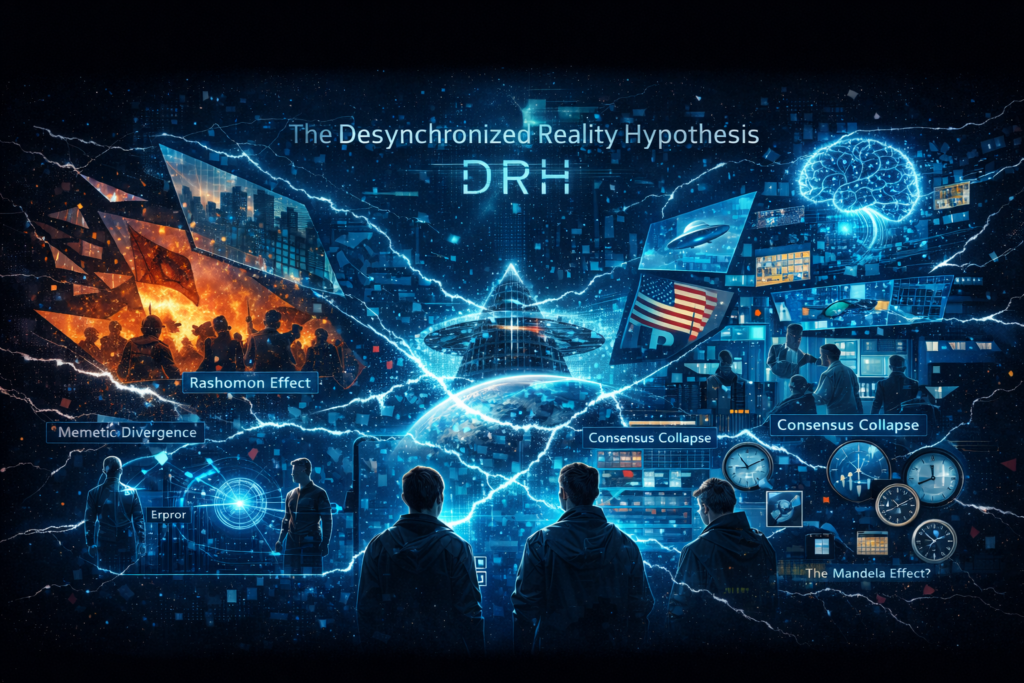
If the DRH is correct, we would expect to observe specific phenomena, all of which are increasingly prevalent in contemporary experience. First, the Rashomon Effect at Scale†18.: multiple witnesses to the same event report not merely different interpretations but seemingly different events entirely. This extends beyond the normal variation of eyewitness testimony to fundamental contradictions in observed content.
Second, Memetic Divergence: the same piece of information or media generates radically different responses in different observer groups, as if they are literally perceiving different content. The famous “dress” debate (blue/black vs. white/gold) may be a minor example of a pervasive phenomenon.
Third, Consensus Collapse: previously stable shared understandings fragment without clear cause. Scientific consensus, historical understanding, and shared cultural knowledge all show accelerating divergence. Fourth, Temporal Confusion: widespread disagreement about when events occurred, with the “Mandela Effect” being a documented example of populations “remembering” events differently than recorded history indicates.
V. The Babel Parallel: Ancient Wisdom on Perceptual Fragmentation
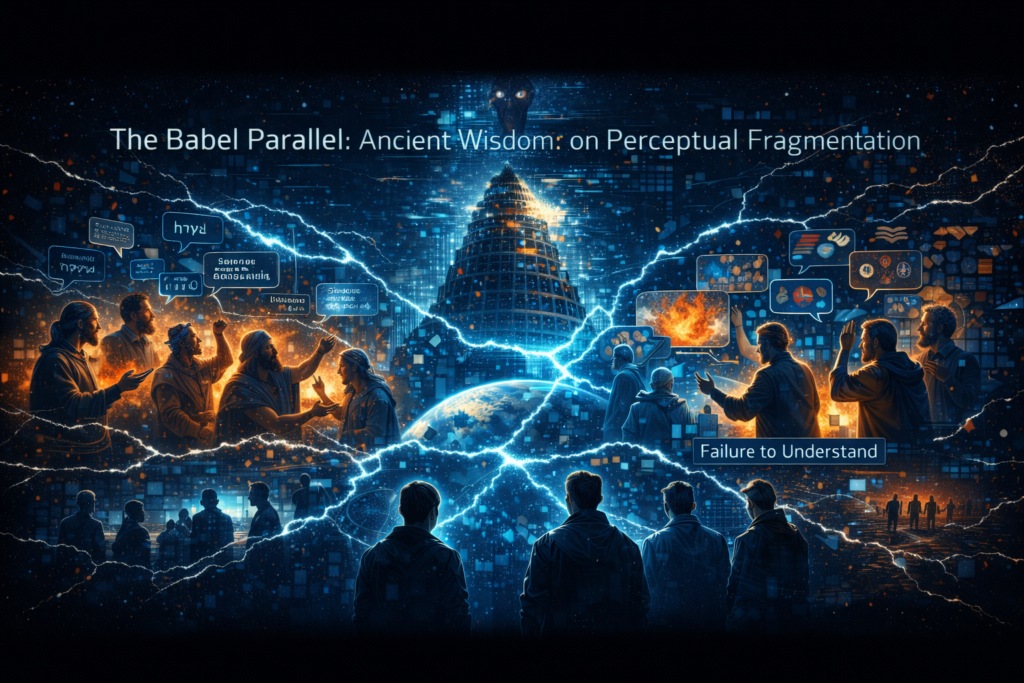
The biblical narrative of the Tower of Babel†9 provides a striking mythological precedent for our hypothesis. In Genesis 11:1-9, humanity begins with “one language and a common speech.” They unite to build a city and a tower reaching to heaven. Upon observing this unified endeavor, the divine intervenes: “If as one people speaking the same language they have begun to do this, then nothing they plan to do will be impossible for them. Come, let us go down and confuse their language so they will not understand each other.”
The standard interpretation focuses on the confusion of language, the inability to communicate through shared verbal symbols. But we propose a deeper reading: what was confused was not merely language but shared reality itself. The passage states not that they spoke differently but that they “will not understand each other.” This understanding failure operates at a level deeper than vocabulary or grammar.
The Talmudic midrash, as noted by Rashi†9, captures this insight: when one builder asked for clay in his language, his colleague understood the sound differently and handed him a brick. The breakdown was not in the words but in the mapping of words to reality. The same auditory input produced different perceptual outputs. “All hell broke loose,” as the commentary notes. This is precisely the phenomenon we observe today: the same information input produces radically different reality outputs across observers.
The Babel story ends with dispersal. Humanity was scattered across the earth, divided into separate communities that can no longer effectively coordinate. This is the trajectory of our current desynchronization: as shared reality degrades, coherent collective action becomes impossible, and society fragments into increasingly isolated perceptual communities, each inhabiting their own rendered version of the world.
VI. Psychological Evidence: The Science of Fractured Perception
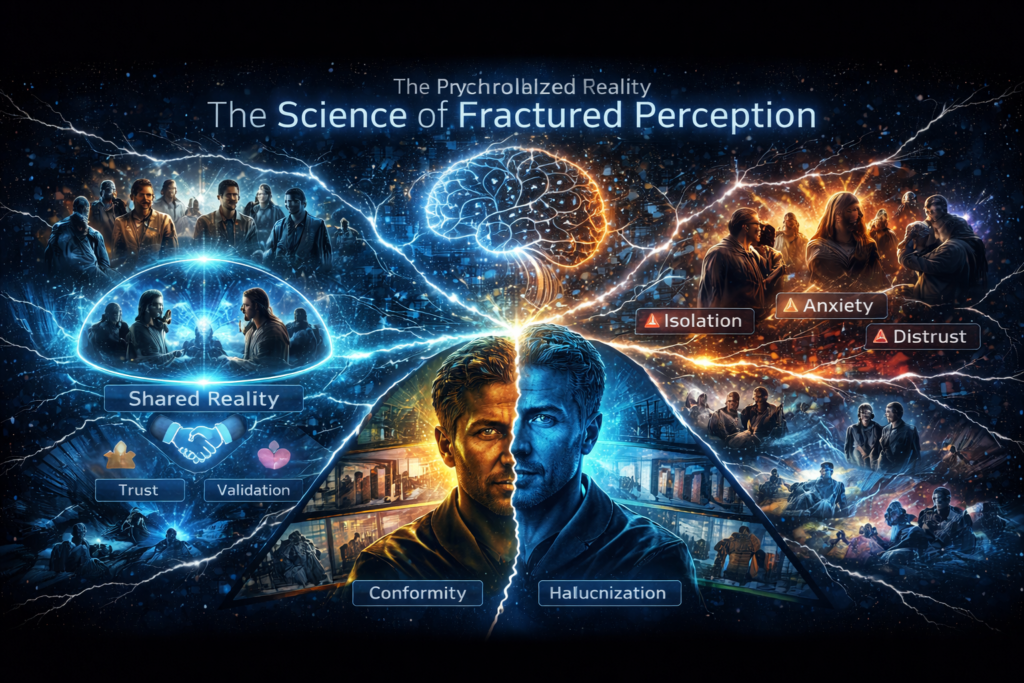
Research on shared reality provides empirical grounding for understanding how perceptual consensus normally functions and why its breakdown has such profound effects. Echterhoff, Higgins, and Levine†8 define shared reality as “a subjectively perceived commonality of inner states about some target referent.” This is not merely agreement; it is the felt sense that one’s experience of reality is validated by and compatible with others’ experience.
Their research demonstrates that humans have a “fundamental need to experience shared reality with others.” When this experience is denied, as in Asch’s famous conformity experiments†15, individuals become “uncertain, uncomfortable, even physically agitated.” Complete removal of shared reality, as in isolation experiments, produces “severe depression…hallucinations and surreal fantasies.”
Rossignac-Milon and colleagues†10 found that shared reality provides both epistemic and relational benefits: “reinforcing our confidence that our perceptions are valid and real” while fostering social connection. Crucially, they found that when shared reality is experimentally threatened, individuals engage in “motivated behaviors to restore their sense of shared reality,” referencing shared memories and inside knowledge.
Higgins’ comprehensive work†14 documents how shared reality “makes us strong” through collective coherence but “tears us apart” when it fractures. His analysis of political and social polarization highlights precisely the dynamics our hypothesis predicts: not mere disagreement about values but increasingly incompatible experiences of the same underlying events.

VII. The Acceleration Pattern
If the DRH is correct, we would expect the phenomenon to accelerate over time, and this is precisely what we observe. The fragmentation of shared reality is not linear but exponential. Each generation of desynchronization makes the next more likely, as children are socialized into already-divergent perceptual communities.
7.0 Historical Acceleration: Media Technologies and Perceptual Divergence
7.1 Social Media as Desynchronization Amplifier
7.2 The Mechanics of Chaos Amplification
7.3 Data-Driven Reality Fragmentation
7.4 Cascading Positive Feedback
7.5 Micro-Fragmentations: The Natural Resynchronization Mechanism
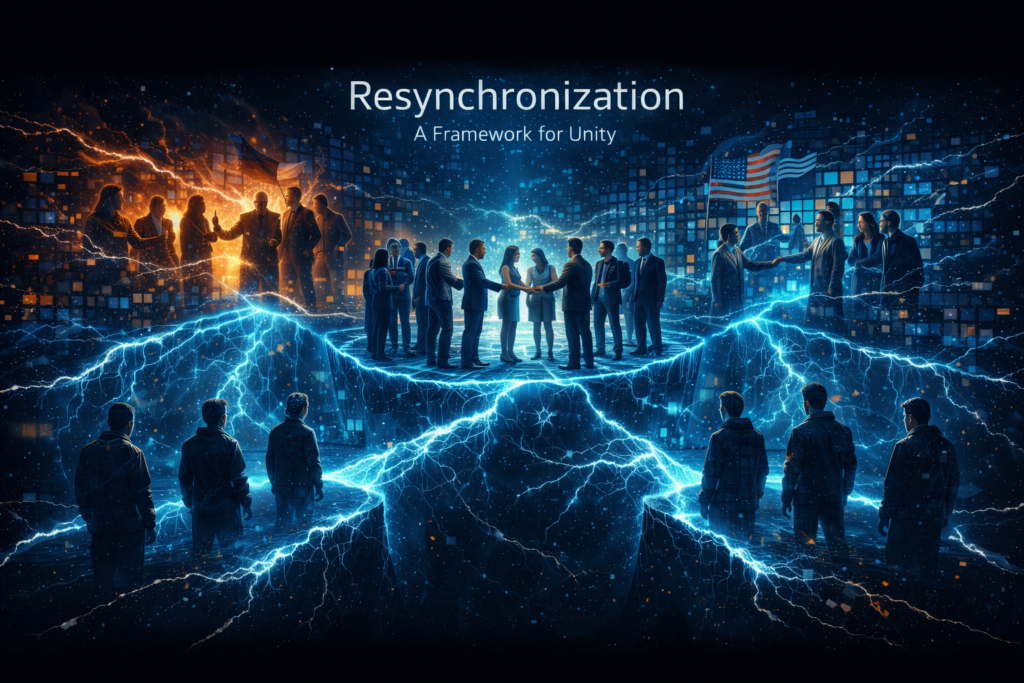
VIII. Resynchronization: A Framework for Unity
If the DRH is correct, is resynchronization possible? We propose that it is, and the pathway is not revolutionary but restorative. The solution is not to create new mechanisms for human understanding but to restore the conditions under which humanity’s ancient resynchronization mechanisms can function.
8.1 Restoring the Conditions for Micro-Fragmentations
8.2 Collective Meta-Awareness as Prerequisite
8.3 Technological Architecture as Enabler
8.4 Simulation-Level Error Correction
8.5 The Restoration of Coherence
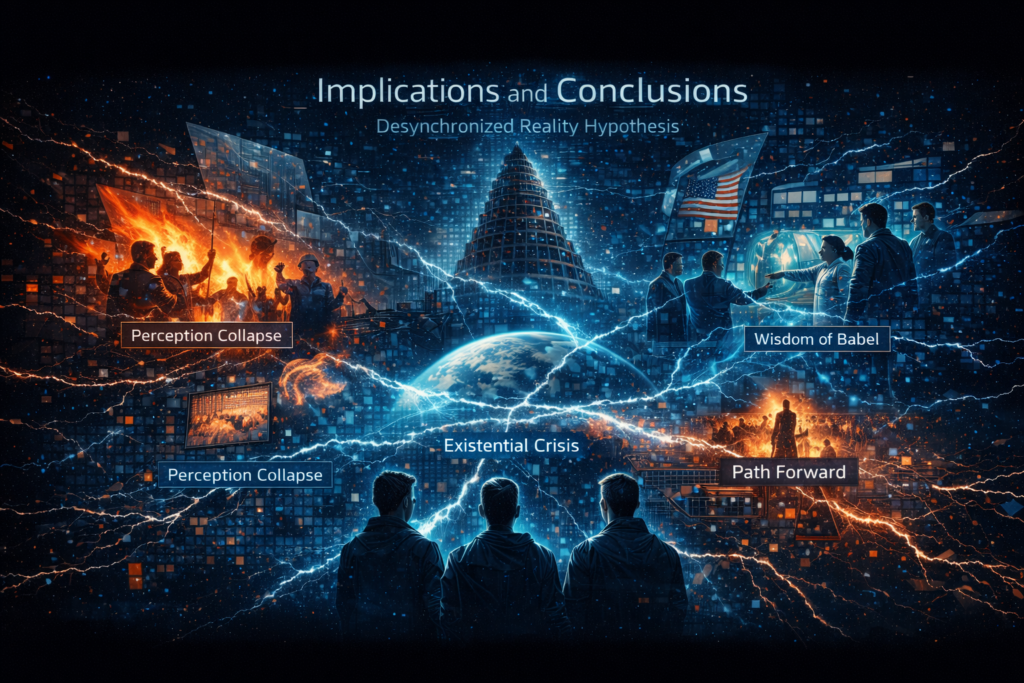
IX. Implications and Conclusions
The Desynchronized Reality Hypothesis offers a novel framework for understanding one of the most troubling phenomena of our age: the collapse of shared perception. If correct, it implies several profound conclusions.
First, the conflict we experience is not fundamentally about values, ideology, or even truth; it is about perception itself. This reframes the challenge from persuasion (changing minds) to synchronization (aligning renderings). The goal is not to prove others wrong but to establish the conditions under which we can agree on what we are perceiving.
Second, the crisis is not merely social or political but metaphysical. We are confronting not a breakdown of institutions or norms but a potential breakdown of the reality substrate itself. This elevates the stakes beyond any particular policy debate to questions of existential coherence.
Third, the ancient narrative of Babel may preserve wisdom about the phenomenon and its resolution. The story suggests that perceptual fragmentation is not unprecedented and may have conditions under which it can be reversed. The Pentecost narrative in Christian tradition, where the confusion of Babel is explicitly reversed through a unifying spiritual experience, may encode a template for resynchronization.
Fourth, the hypothesis suggests that unity is possible, not through the victory of one perceptual community over others, but through the restoration of coherent shared rendering. This unity would not require uniformity; it would require only that our diverse experiences be compatible rather than contradictory.
We offer this hypothesis not as proven fact but as a framework for investigation. The evidence supporting simulation theory, information-theoretic reality, and participatory observation is substantial. The evidence for specific desynchronization mechanisms remains speculative. What is not speculative is the phenomenon itself: shared reality is fracturing, and the fracture is accelerating.
Whether the cause is technological, psychological, sociological, or metaphysical, the imperative remains the same: we must find our way back to each other. We must learn to see together once more. The tower we are building today, global civilization, interconnected humanity, collective flourishing, will stand or fall on our ability to restore the coherent perception we have lost.
Perhaps the simulation is testing us. Perhaps the desynchronization is not a bug but a feature, an obstacle we must overcome to reach the next level of collective consciousness. Or perhaps it is simply entropy taking its toll on an aging system. Whatever the cause, the path forward is the same: recognition, reconciliation, and resynchronization.
Only then will we become, once more, one people with one perception, capable of building our tower together.
Coming Next:
II. Theoretical Foundations
III. The Observer Effect and Participatory Reality
IV. The Desynchronized Reality Hypothesis
V. The Babel Parallel: Ancient Wisdom on Perceptual Fragmentation
VI. Psychological Evidence: The Science of Fractured Perception
VIII. Resynchronization: A Framework for Unity
IX. Implications and Conclusions
Get Updates
Sign up to receive updates as we roll out new sections and stories. Guess what we’ll be sharing in the next section.
References
†1 Bostrom, N. (2003). “Are We Living in a Computer Simulation?” Philosophical Quarterly, Vol. 53, No. 211, pp. 243-255.
†2 Wheeler, J.A. (1990). “Information, Physics, Quantum: The Search for Links.” Proceedings of the 3rd International Symposium on Foundations of Quantum Mechanics, Tokyo, pp. 354-368.
†3 Bekenstein, J. (2003). “Information in the Holographic Universe.” Scientific American, August 2003.
†4 Susskind, L. (1995). “The World as a Hologram.” Journal of Mathematical Physics, 36(11), pp. 6377-6396.
†5 Maldacena, J. (1997). “The Large N Limit of Superconformal Field Theories and Supergravity.” Advances in Theoretical and Mathematical Physics, 2, pp. 231-252.
†6 ‘t Hooft, G. (1993). “Dimensional Reduction in Quantum Gravity.” arXiv:gr-qc/9310026.
†7 Buks, E., Schuster, R., Heiblum, M., Mahalu, D., & Umansky, V. (1998). “Dephasing in electron interference by a ‘which-path’ detector.” Nature, 391, pp. 871-874.
†8 Echterhoff, G., Higgins, E.T., & Levine, J.M. (2009). “Shared Reality: Experiencing Commonality with Others’ Inner States About the World.” Perspectives on Psychological Science, 4(5), pp. 496-521.
†9 Genesis 11:1-9, The Tower of Babel. Hebrew Bible / Old Testament.
†10 Rossignac-Milon, M., Bolger, N., Zee, K.S., Boothby, E.J., & Higgins, E.T. (2021). “Merged Minds: Generalized Shared Reality in Dyadic Relationships.” Journal of Personality and Social Psychology, 120(4), pp. 882-916.
†11 Musk, E. (2016). Remarks at the Recode Code Conference. “There’s a one in billions chance we’re in base reality.”
†12 Kipping, D. (2020). “A Bayesian Approach to the Simulation Argument.” arXiv:2001.09522.
†13 Wolfram, S. (2023). “Observer Theory.” Stephen Wolfram Writings.
†14 Higgins, E.T. (2019). Shared Reality: What Makes Us Strong and Tears Us Apart. New York: Oxford University Press.
†15 Asch, S.E. (1951). “Effects of Group Pressure Upon the Modification and Distortion of Judgments.” In H. Guetzkow (Ed.), Groups, Leadership and Men, pp. 177-190.
†16 Bohm, D. (1980). Wholeness and the Implicate Order. London: Routledge & Kegan Paul.
†17 Penrose, R. (1989). The Emperor’s New Mind. Oxford University Press.
†18 Kurosawa, A. (1950). Rashomon [Film]. Daiei Film Company.
* References continue to be verified. Additional references being researched.
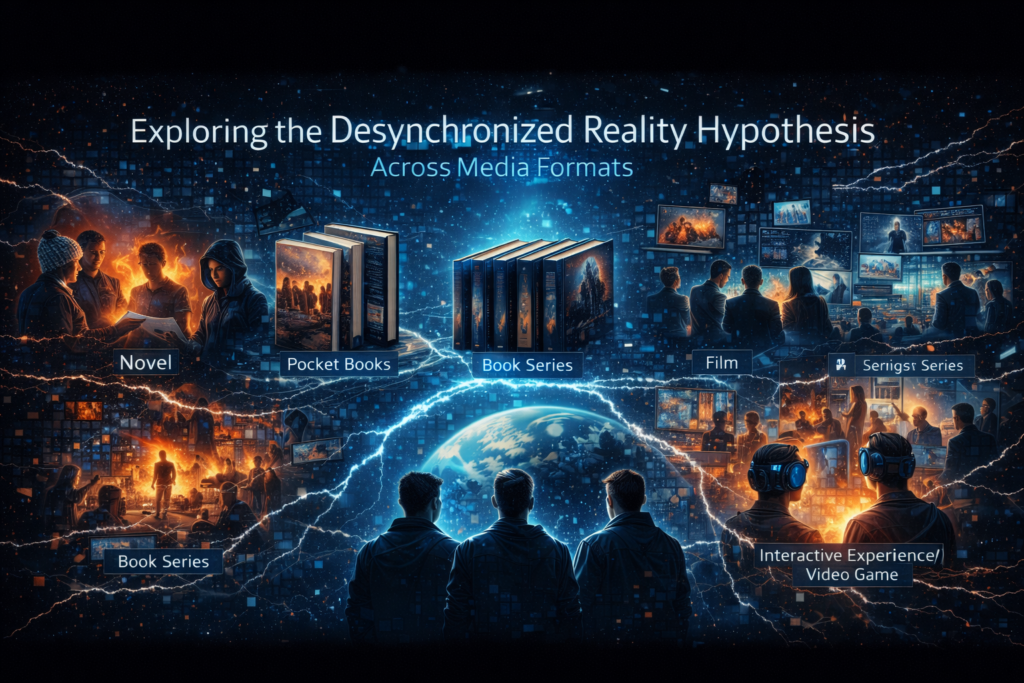
Afterword: Creative Applications
This treatise was developed not only as a speculative scientific document but as a conceptual foundation for creative works across multiple media. The Desynchronized Reality Hypothesis lends itself to exploration and creation of materials in the following formats:
Novel
Already in process, this literary work follows individuals who become aware of the desynchronization, forming an underground movement to achieve resynchronization while navigating a world where no two people perceive the same reality. The narrative structure itself could mirror the theme, with chapters presented from perspectives that subtly contradict each other.
Pocket Books
Partially licensed, the Desynchronized Reality Hypothesis offers a unique opportunity for print-on-demand customized pocket books that blur the line between mass media and personal artifact. Each physical copy becomes a singular object—no two readers hold the same book in their hands.
Customization Engine: At the point of purchase, readers answer a brief series of questions or provide seed data (birth date, location, a chosen word). This information feeds an algorithm that generates subtle variations throughout the text. Names shift, locations transpose, certain passages expand while others contract. The core narrative remains coherent, but the texture of the reading experience diverges from copy to copy.
Physical Format: Small enough to fit in a pocket, these books invite casual reading in public spaces. Their diminutive size belies their conceptual weight. The tactile experience—paper stock, cover texture, binding method—could also vary between copies, making each book feel materially unique.
Social Discovery: Readers encountering each other might compare passages, discovering that the character one reader found sympathetic appears more ambiguous in another’s copy. Reading groups become exercises in mapping divergence. Online forums would fill with readers attempting to catalog variations, never quite succeeding because the variation space is vast.
Real-Time Responsiveness: For limited runs, the generation algorithm could incorporate real-time data—news headlines, weather patterns, trending topics—from the moment of printing. A book ordered on a sunny Tuesday in March reads differently than one ordered during a thunderstorm in November. The text becomes a time capsule of its own creation moment.
Possible Collectibility and Scarcity: Each copy’s unique ISBN or edition code allows verification of its singular nature. Collectors might seek copies generated under specific conditions or containing rare variant passages. The secondary market becomes a hunt for divergence patterns rather than traditional first editions.
Serialized Releases: A sequence of pocket books released over months could tell a story that shifts based on when each reader enters the series. Early adopters receive one narrative thread; latecomers receive another. The “complete” story exists only in the aggregate of all copies ever printed, a narrative that no single reader can fully possess.
Book Series
A multi-volume book series allows the Desynchronized Reality Hypothesis to unfold across an epic narrative scope, with each installment deepening the exploration of fragmented perception while building toward an eventual resynchronization.
Series Architecture: The series would span five to seven volumes, each capable of standing alone while contributing to a larger arc. Early volumes establish the world and the dawning awareness of desynchronization; middle volumes explore the consequences across society, relationships, and individual psychology; final volumes chart the difficult path toward collective recognition and reintegration.
Rotating Protagonists: Each book centers on a different protagonist operating in a different domain—a journalist, a physicist, a politician, a child, an elderly person losing the ability to distinguish desynchronization from memory loss. Their paths intersect at key moments, and readers gradually realize these characters have been present in each other’s narratives, perceived differently.
Contradictory Canon: Events described in one volume appear differently in subsequent volumes, not through retcon but through the explicit acknowledgment that characters experienced them divergently. A pivotal meeting described as hostile in Book Two appears collaborative in Book Four. Neither account is wrong. Readers must hold multiple versions simultaneously.
Appendices and Marginalia: Each volume includes supplementary materials—academic papers, news clippings, personal letters, internet forum threads—that exist within the world and reflect the desynchronization. A scientific paper in Book Three might be cited in Book Five, but the citations don’t quite match the original, reflecting how even documented knowledge drifts.
Reader Companion Volume: A final companion volume could serve as a “synchronization guide,” attempting to map the divergences across the series and offering one possible unified timeline. But the companion itself would contain subtle internal contradictions, suggesting that even the attempt to document shared reality falls prey to the phenomenon it describes.
Thematic Progression: The series would move through stages mirroring the treatise’s framework—from initial subtle divergence, through acceleration and crisis, toward the hard-won possibility of resynchronization. The emotional arc carries readers from unease through despair to cautious hope, modeling the psychological journey the hypothesis predicts for humanity.
Film
A visual medium that can literally show the same scene rendered differently for different characters. The film would build toward a climactic moment of collective recognition, cinematically represented through a gradual alignment of previously divergent visual presentations.
Series
An episodic format allowing deep exploration of how the desynchronization affects different domains: politics, science, relationships, art. Each season could escalate the desynchronization while building toward an eventual resynchronization arc, with individual episodes exploring the phenomenon from diverse perspectives.
Interactive Experience / Video Game
The Desynchronized Reality Hypothesis provides an exceptionally rich foundation for interactive entertainment, offering gameplay mechanics that have never been fully explored in the medium. The core concept, that players must cooperate despite receiving fundamentally contradictory information about their shared environment, creates unprecedented design possibilities.
Core Gameplay Concept: Players inhabit the same game world but perceive it differently. Where one player sees a locked door, another sees an open passage. Where one player sees an ally, another sees an enemy. Where one player reads a sign saying “SAFE,” another reads “DANGER.” Success requires players to develop meta-communication protocols to identify these divergences and coordinate action despite them.
Multiplayer Architecture: The game would feature asymmetric multiplayer where 2-8 players share a persistent world. Each player’s client renders a subtly different version of the environment, NPCs, objects, and text. Some elements remain constant across all players (anchor points) while others diverge wildly. The degree of divergence could increase as players progress, representing the accelerating desynchronization described in the treatise.
Communication Mechanics: Players cannot simply describe what they see, as even their language may be subject to desynchronization. A player saying “the red door” might have their message rendered as “the blue door” to another player. Players must develop indirect communication strategies: pointing, demonstrating, drawing maps, and creating shared reference points through action rather than description.
Puzzle Design: Environmental puzzles would require players to combine information that no single player possesses. Player A sees a combination lock; Player B sees the combination written on a wall that appears blank to Player A. But Player B cannot simply tell Player A the numbers, as the numbers may render differently. Players must find ways to communicate the pattern or relationship rather than the raw data.
Narrative Integration: The story unfolds through fragments that each player receives differently. Assembling the true narrative requires players to share their pieces and identify which elements are consistent versus divergent. Major plot revelations come from moments when players realize their fundamental assumptions about the game world have been different all along.
Synchronization Mechanics: Certain actions or locations allow temporary synchronization, giving all players the same view briefly. These “sync points” become precious resources, used strategically to calibrate understanding before tackling major challenges. Players might discover rituals, technologies, or locations that enable synchronization, echoing the resynchronization framework from the treatise.
Trust and Social Dynamics: Because players cannot verify each other’s perceptions directly, trust becomes a gameplay element. Is your teammate genuinely seeing something different, or are they deceiving you? The game could include traitor mechanics where some players are secretly working toward different goals, their divergent perceptions serving as cover for deliberate misinformation.
Single-Player Mode: A solo campaign could feature the player character experiencing progressive desynchronization from NPCs and their own past self. Returning to previously visited areas reveals changes, some real and some artifacts of the player’s shifting perception. The player must distinguish between actual changes to the world and changes to their rendering of it.
VR/AR Implementation: Virtual and augmented reality platforms offer the ideal medium for this concept. In VR, players occupying the same virtual space would see genuinely different environments. In AR, the overlay on the real world could differ between players, creating gameplay that bleeds into reality. Imagine AR players looking at the same physical building but seeing different virtual elements superimposed on it.
Competitive Modes: Beyond cooperative play, competitive modes could pit teams against each other where each team perceives the battlefield differently. Victory goes not to the team with superior reflexes but to the team that most accurately maps the true underlying reality beneath their divergent perceptions.
Procedural Divergence: Using procedural generation, each playthrough would create unique divergence patterns. No guide or walkthrough could fully prepare players, as the specific ways their perceptions differ would be generated fresh. This ensures replayability and maintains the core experience of genuine uncertainty about shared reality.
Accessibility and Difficulty: Difficulty settings would control the degree and frequency of divergence. Entry-level play might feature clear “sync zones” and limited divergence types. Expert play would feature pervasive divergence affecting every aspect of the game, including UI elements, inventory displays, and even the pause menu.
Thematic Resonance: Beyond entertainment, the game would serve as an experiential teaching tool. Players would viscerally understand what it feels like when shared reality breaks down, and they would develop practical skills for coordinating with others despite perceptual disagreement. These skills, empathy, indirect communication, trust-building, patience, and assumption-questioning, transfer directly to real-world contexts where we increasingly struggle to share a common reality.
Technical Innovation: Implementing true perceptual divergence in multiplayer requires novel networking architecture. Rather than synchronizing game state across clients, the server would maintain the “true” underlying state while each client applies unique divergence transforms. This inverts the normal multiplayer paradigm and could advance the field of asymmetric game design.
The concept’s resonance with contemporary experience ensures relevance; its grounding in legitimate scientific theory ensures depth; its optimistic framework ensures hope. Together, these elements create a rich foundation for meaningful creative work across any medium.
Legal Notices and Intellectual Property Declaration
COPYRIGHT NOTICE: This entire work, including all text, theories, hypotheses, frameworks, terminology, narrative concepts, and creative elements contained herein, is protected by copyright law. Copyright © 2026 John Kirker Inc., a California corporation established October 19, 2000. All rights reserved. Registration with the United States Copyright Office is pending. This work is protected under the laws of the United States and by international treaties and conventions.
TRADEMARK NOTICE: The following marks are claimed as trademarks of John Kirker Inc. and may not be used without express written permission: DESYNCHRONIZED REALITIES™, THE BABEL HYPOTHESIS™, DESYNCHRONIZED REALITIES HYPOTHESIS™, DESYNCHRONIZED REALITY HYPOTHESIS™, DRH™, COHERENCE LAYER™, RASHOMON EFFECT AT SCALE™, MEMETIC DIVERGENCE™, CONSENSUS COLLAPSE™, TEMPORAL CONFUSION™, RESYNCHRONIZATION™, RESYNCHRONIZATION PROTOCOL™, RESYNCHRONIZED REALITY™, SIMCHAOS™, SIMULATION CHAOS™ and SIMULATION CHAOS THEORY™ (in the context of this work).
CORPORATE OWNERSHIP: All intellectual property rights in and to this work are owned exclusively by John Kirker Inc., a California corporation, with its principal place of business in the State of California. John J. Kirker is the author of this work, which was created as a work made for hire or has been assigned to John Kirker Inc.
RESERVATION OF RIGHTS: John Kirker Inc. expressly reserves all rights in and to this work, including but not limited to: the right to produce derivative works in any medium; the right to adapt this work for film, television, streaming, or other audiovisual media; the right to adapt this work for theatrical production; the right to adapt this work for video games, interactive media, virtual reality, augmented reality, or any other interactive entertainment format; the right to produce merchandise based on this work; the right to license any of the above rights to third parties; the right to translate this work into other languages; the right to produce audio versions of this work; the right to produce sequels, prequels, or related works; and all other rights not expressly granted herein.
PROHIBITION ON UNAUTHORIZED USE: No person or entity may reproduce, transmit, distribute, adapt, translate, publicly perform, publicly display, or create derivative works based on this work or any portion thereof without the express prior written consent of John Kirker Inc., except in the case of brief quotations embodied in critical reviews and certain other noncommercial uses permitted by copyright law. Contact us for permission requests.
LIMITATION OF LIABILITY: This work presents speculative theories for intellectual exploration and creative purposes. John Kirker Inc. makes no representation that the theories presented herein are scientifically proven or represent objective truth. Readers assume all risk associated with their interpretation and application of the ideas contained herein.
CONTACT FOR LICENSING: All inquiries regarding licensing, adaptation rights, or permissions should be directed to John Kirker Inc. or its designated representative. Unauthorized use will be prosecuted to the fullest extent of the law.
INTERNATIONAL PROTECTION: This work is protected under the Berne Convention for the Protection of Literary and Artistic Works, the Universal Copyright Convention, the WIPO Copyright Treaty, the Agreement on Trade-Related Aspects of Intellectual Property Rights (TRIPS), and all applicable national laws of countries signatory to these agreements. Patent pending.
NOTICE TO PRODUCERS AND DEVELOPERS: This work has been registered and documented with dated proof of creation. Any production company, game developer, studio, network, streaming service, or other entity developing content substantially similar to the concepts presented herein should be aware that John Kirker Inc. will vigorously defend its intellectual property rights.
GOVERNING LAW: This work and all associated intellectual property rights shall be governed by and construed in accordance with the laws of the State of California and applicable federal law of the United States of America. Any disputes arising from unauthorized use of this work shall be subject to the exclusive jurisdiction of the state and federal courts located in California.
Copyright © 2026 John Kirker Inc.
A California Corporation
All Rights Reserved Worldwide
Version 1.4
First Edition
Originally Published: January 11, 2026
Made Public: January 16, 2026
Last Updated: January 12, 2026
DESYNCHRONIZED REALITIES™, THE BABEL HYPOTHESIS™, DESYNCHRONIZED REALITIES HYPOTHESIS™, DESYNCHRONIZED REALITY HYPOTHESIS™, DRH™, COHERENCE LAYER™, RASHOMON EFFECT AT SCALE™, MEMETIC DIVERGENCE™, CONSENSUS COLLAPSE™, TEMPORAL CONFUSION™, RESYNCHRONIZATION™, RESYNCHRONIZATION PROTOCOL™, RESYNCHRONIZED REALITY™, SIMCHAOS™, SIMULATION CHAOS™, and SIMULATION CHAOS THEORY™ are trademarks of John Kirker Inc.
No part of this publication may be reproduced, distributed, or transmitted in any form or by any means, including photocopying, recording, or other electronic or mechanical methods, without the prior written permission of John Kirker Inc., except in the case of brief quotations embodied in critical reviews and certain other noncommercial uses permitted by copyright law. Contact us for permission requests.
This work includes original theories, hypotheses, concepts, narrative frameworks, and creative elements that are the exclusive intellectual property of John Kirker Inc. Any adaptation, derivative work, translation, film production, television production, streaming production, theatrical production, video game development, interactive media development, virtual reality application, augmented reality application, merchandise creation, or other commercial exploitation requires express written authorization from John Kirker Inc. and appropriate licensing agreements.
The scientific and philosophical concepts discussed herein, while drawing upon publicly available research, are synthesized, interpreted, and extended in novel ways that constitute original creative and intellectual work protected under applicable copyright, trademark, and intellectual property laws of the United States and international treaties including the Berne Convention, Universal Copyright Convention, and WIPO Copyright Treaty.
Library of Congress Registration Pending
ISBN: Pending
US Patents Pending
© 2026 John Kirker Inc.
A California Corporation
Established October 19, 2000
All Rights Reserved Worldwide
End of Document